Resentment vs Gratitude
..and my tropical travels
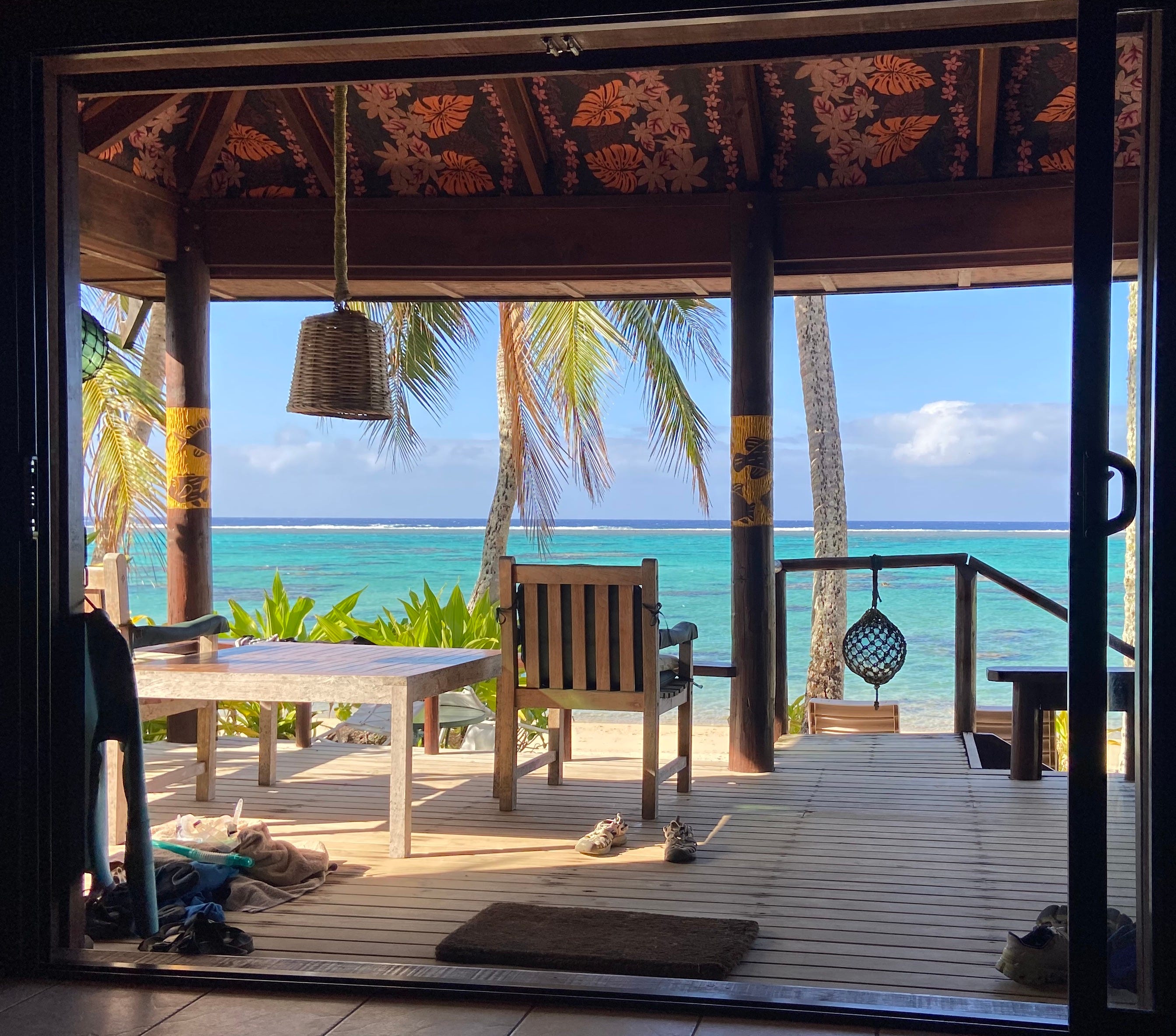
Last year my husband and I visited Rarotonga. It was a long-awaited trip looked forward to throughout a busy year. Every time I felt life was a bit tough, I imagined myself on those white-sand, blue-sky beaches. We arrived to sure enough to white sand, coconut palms and blue skies just exactly as I had imagined it, but looking back, my memory is clouded instead by resentment: at the steady winds that blew across the beach making it uncomfortably cool, at the raging itchiness I developed with a heat rash, and at the inability to feel restful despite nothing but searingly beautiful aquamarine seas to look out upon. I resented the “difficult” circumstances and allowed myself to wallow in it.
One year on, as I write this, I am currently sitting on a stony beach on a different tropical holiday overlooking a brown, swollen river overshadowed by a clutch of sheltering trees in the jungles of North Sumatra. They hover like midwives over our morning fire as we cook on sticks our freshly caught fish for breakfast. I have red spots all over me from leech bites, stinging flies and potentially malaria-ridden mosquitoes. Tropical storms with thunder and forked lightning have assaulted us every evening… yet I feel content. More than content. Deeply at peace here and with a heart swollen full with gratitude. To lie by this river, serenaded by the song of cicadas and a thousand other jungle creatures all the black night through, has left me soaked in a sense of warmth and tranquillity. In fact, I find I am faced with another dilemma entirely: that of letting go of this tropical paradise. I can’t bear the thought of returning to the concrete jungle with its sirens and exhaust smoke back home.
What is different this time? The difference is that I have spent a year cultivating a practice of gratitude. There has been more to grieve and more to face in this past year than almost ever before in my parenting journey. In desperation, earlier this year, I began to read about gratitude and I realised I had a choice: to learn to be grateful or to be crippled by the emotional pain I was facing.
The thing is that parenting can be rather like my trip to Rarotonga - it all depends on your perspective. Parenting can be an island paradise with the potential to nourish and feed us with all its amazingness or we can resent its reality such as the stray dogs, the winds, the mosquitos and the heat (read: sleepless nights, sibling rivalry, tousles over chores etc). And parenting complex and challenging kids leaves us with plenty to resent. More so than the average parent, we are beset with tantrums, school issues, behavioural challenges and our child’s ongoing health issues. These issues can accumulate to disrupt our ability to think straight, to manage work commitments or to find rest and support when we most need it. Resentment feels like the more sane response than that annoying sentiment…gratitude?!
I personally am no natural at gratitude. I have long resented shiny-faced, smiley people telling me to “Be happy!” I’d far rather wallow in my self-pity than float along on a fake high pretending to other people that everything is alright when it’s really NOT. I’ve long prided myself on being “real” and admitting to finding things tough when they are. That is, until things got so tough, and I had spiralled in my resentment and misery for so long, it began seriously affecting my own health and wellbeing.
Although it’s easy to feel resentful and sorry for ourselves about the things we find hard, it’s actually no good for our health. Trauma expert Gabor Mate in his ground-breaking book The Myth of Normal speaks about the irrefutable connection between mind and body and how negative emotions can seriously impact on our health and wellbeing. Allowing ourselves to stew in resentment and self-pity can cause a slurry of physiological reactions that can lead to serious illness and even death. However it is not so much the negative feelings themselves that seem to cause disease, than the repressing of those feelings. Mate describes a woman with cancer who found herself “seething with resentment” in later life at the early neglect she suffered as a child. Unable to express her rage, however, she instead disconnected herself from her feelings and became very ill instead.[1] People who repressed their feelings, Mate came to realise, were the ones who showed up at his practice with chronic illness, and the ones under his palliative care.
It seems there is a line to walk between repressing our feelings, pretending that all is well, and facing into our raw emotions. All of them. And then coming out the other side, having acknowledged our grief, our rage and our pain to find that life is indeed good, despite all. Diana Butler Bass, author of Grateful says, “Every day there are reasons not to feel grateful. Terrible, distressing, painful and awful things happen all the time. Yet gratitude is a defiance, of sorts. The defiance of kindness in the face of anger, of connection in the face of division and of hope in the face of fear.”[2]
This is the place for gratitude. Not on the other side of the maelstrom but in the very midst of the storm. And research shows that finding gratitude here is very good for our health. Those who exhibit gratitude readily are more likely to be fitter, physically healthier, more likely to avoid serious illnesses such as heart disease, more likely to sleep better, and to stay healthier overall.[3] Gratitude actually calms your entire nervous system helping you feel more content about your life. In fact, gratitude can be so powerful that for those who practice it regularly it rewires your brain to make you more likely to make healthier choices, to be better at relating to others and more resilient in the face of adversity.[4]
Raising my complex child has been a genuinely tough road, but the truth is, I could get so caught up in this story of resentment around parenting this challenging child that I could allow her entire childhood and that of her brothers’ go the way of our holiday in Rarotonga: left with the taint of resentment and self-pity, and missing the truth of the amazingness of it all. Because it’s not true that hardship is the whole story of my parenting. If I only look at what I have to feel sorry about I completely miss the incredible moments that unfold before my very eyes.
My parenting story is peppered with such joy. Mine is a child capable of such delight, and of such deep compassion. I remember her younger self sobbing uncontrollably in distress once over a news item about dolphins being rounded up in pods and killed, the sea running red with their blood. And will I ever forget that look of delight when I first took her tramping overnight in the bush as a child? She was enthralled by the green trees, the blue skies and the soaring rock buttresses we climbed around. You can’t bottle moments like that. You just have to cherish them.
Psychologist Gordon Neufeld talks of the importance of maintaining a firm but caring alpha lead with our complex kids.[5] It strikes me that belly-aching about my difficulties to others and feeling perpetually the victim of circumstance is hardly what he meant by taking the lead. Resentment puts me on the back foot. Gratitude, however, puts me back in charge of my own narrative and of my own parenting story.
I once saw those forever-grateful types as weak and disillusioned about the realities of life. I now see gratitude as something more like a battle sword, cutting through the cloying cords of self-pity, resentment and shame and putting me firmly back in a place where true joy, contentment and even “happiness” is attainable despite pressingly difficult circumstances.
There were times in this trip to the jungle that I came close to wallowing again. The road to the jungle was seriously pitted with potholes. We were bumped and juddered along it all day long with no lunch only to arrive at a jungle hotel with no apparent host, limited English and no restaurant or shops in sight. However, despite booming, tropical thunder and lashing rain that lasted for hours through the evening, we were eventually guided to a small, friendly restaurant that offered us a simple meal. We went to bed on a mattress on the floor of our wooden hut with full tummies, my heart fuller still, listening to the gentle river pass us by.
You know it’s a funny thing, but it’s not just the joys I have come to appreciate about our children, but also the difficulties too. Raising this complex child has grown me up like possibly nothing else ever could. I am twice the person I would be had I not weathered the pain of loving through such immensely trying times. Our tamariki are the greatest gifts we will ever be given. Let’s be grateful for what they bring us: both the delightful and the difficult.
[1] Gabor Maté, The Myth of Normal: Trauma, Illness, and Healing in a Toxic Culture (Penguin, 2022).
[2] Diana Butler Bass, Grateful: The Subversive Practice of Giving Thanks (HarperCollins, 2018).
[3] ‘Giving Thanks Can Make You Happier’, Harvard Health, 14 August 2021, https://www.health.harvard.edu/healthbeat/giving-thanks-can-make-you-happier.
[4] Misty Pratt, ‘The Science of Gratitude’, Mindful (blog), 17 February 2022, https://www.mindful.org/the-science-of-gratitude/.
[5] Alpha Children (Vancouver: Mediamax Interactive Productions, 2012)
.


Thank you for sharing that beautiful story. It's so true that our children grow us up!!